
Application of Platelet aluminum oxide in grinding and polishing monocrystalline and polycrystalline silicon wafers
Platelet aluminum oxide (plate-shaped / hexagonal plate-shaped α-Al₂O₃, comparable to the Japanese Fujimi PWA series) is a high-purity flat hexagonal crystal with controllable aspect ratio and blunted edges. It is the mainstream precision abrasive for thinning, grinding and pre-polishing processes after silicon wafer slicing. It is widely used in double-sided grinding, edge chamfering and pre-CMP polishing processes of monocrystalline silicon wafers and photovoltaic-grade polycrystalline silicon wafers, perfectly solving the shortcomings of ordinary corundum abrasives that are easy to scratch and have large subsurface damage.
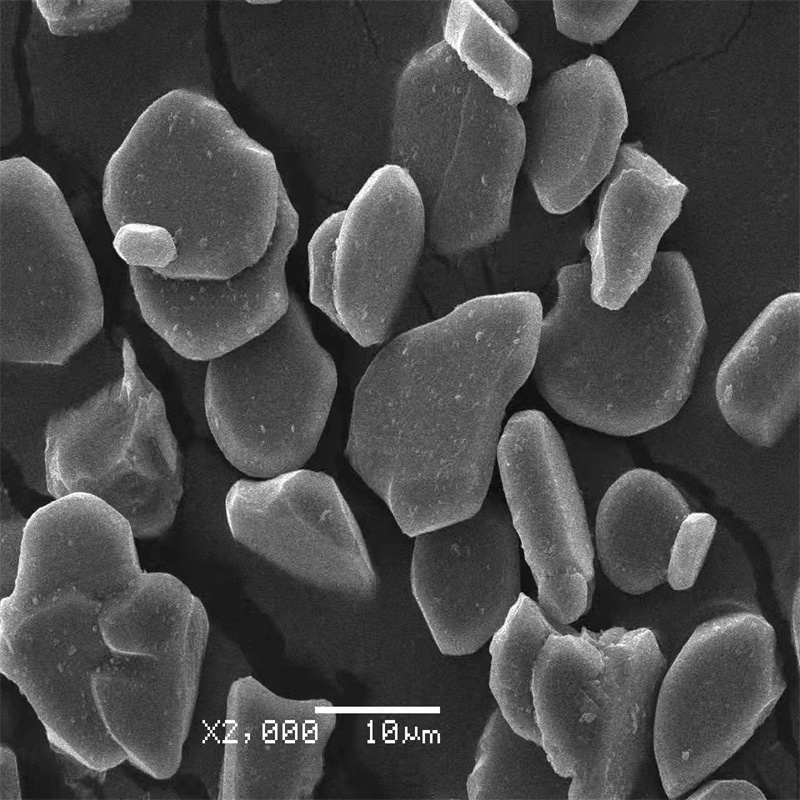
一 Characterisitics of platelet aluminum oxide
1.Crystal phase and purity: The crystal form is α-al2O3, with a Mohs hardness of 9; the purity is ≥99%, with low sodium, low iron, and low magnetic impurities to avoid metal ion contamination of silicon wafers; it has strong chemical inertness and does not hydrolyze in water-based polishing slurries.
2.Unique platelet Morphology : The particles are flat hexagonal wafers with smooth edges and no sharp corners. During grinding, the particles lie flat and adhere to the silicon wafer surface, using planar sliding grinding instead of sharp-corner micro-cutting. The pressure is evenly distributed, the particles are not easily broken, and the pitting scratches and deep subsurface damage layers are significantly reduced.
3.Particle size controllability: Particle size can be precisely adjusted; the particle size distribution range is narrow, the grinding consistency is high, and over-grinding defects are less likely to occur.
二.Application of multi-process technology on monocrystalline silicon wafers
1.After slicing, coarsely grind both sides.
Applications: To remove surface irregularities and cutting damage layers caused by inner circle cutting and wire cutting, and to control the total thickness deviation of silicon wafers.
Abrasive selection: 1.5-5 μm flat alumina, formulated into a water-based grinding suspension for use on the cast iron grinding disc of a double-sided grinding machine.
Process effects: Compared with ordinary white corundum, the material removal rate is more stable, and the thickness of the subsurface damage layer is reduced from 8-12 μm to 3-5 μm; there are no dense micro-scratches on the silicon wafer surface, and the subsequent polishing time is shortened by more than 30%; abrasive consumption is reduced by 40%, and the wear of the equipment grinding disc is less.
2.Single crystal silicon wafer edge chamfering and edge grinding
The edges of silicon wafers are stress concentration areas, and conventional abrasives such as white corundum or green silicon carbide can easily cause edge chipping and microcracks. Flat alumina particles provide gentle and uniform cutting to the edges of silicon wafers, effectively suppressing edge microcracks and improving the yield of subsequent high-temperature epitaxy and bonding processes. It is a dedicated abrasive for polishing the edges of semiconductor wafers.
3.Pre-polishing (CMP pre-grinding)
Selection: Ultra-fine flat alumina, paired with a polyurethane abrasive pad, as a leveling process before chemical mechanical polishing.
Objective: To reduce surface roughness Ra to 0.8–1.5 nm, significantly shorten the polishing time of the final silica CMP slurry, reduce CMP consumable costs, reduce scratch defects, and improve wafer yield to over 99%.
三.Large-scale application on photovoltaic polycrystalline silicon wafers
After polycrystalline silicon ingots are squared, silicon blocks are sliced. There are two main scenarios for the mass production grinding of photovoltaic polycrystalline silicon wafers:
1. Double-sided leveling and grinding of polycrystalline silicon wafers: Traditional free abrasives use irregular alumina, which easily produces intergranular scratches at the grain boundaries of polycrystalline silicon. Flat alumina sliding grinding has a gentle action and will not produce groove defects along the grain boundaries, ensuring uniform thickness of the entire polycrystalline silicon wafer, reducing line breakage problems when printing silver paste, and is suitable for the pretreatment process of PERC and TOPCon cell silicon wafers.
2. Grinding for thinning ultra-thin polycrystalline silicon wafers: For ultra-thin silicon wafers, the cutting force of the flat abrasive is gentle, which effectively prevents the silicon wafer from warping and cracking, and greatly improves the pass rate of ultra-thin silicon wafer grinding.


